Part 5 of the Introducing One Transit series: the “I” of TONICS
As I’ve spoken about the One Transit strategy, a common objection I hear is, “Yeah, but what about the last 50 feet?” And it’s a great point: the entire trip succeeds or fails in successfully navigating the transfer. Solving this is the job of our fourth tonic: Infrastructure.
Infrastructure is the capital and service investments that make transfers seamless. In a One Transit strategy, infrastructure has two parts:
(1) the Capital Infrastructure of physical assets, and
(2) the Service Infrastructure of human support.

The good news is that you’re already making these investments; your opportunity is in connecting the dots to unlock their true potential for encouraging mode-shift for your paratransit riders.
Universal Accessibility Can Slash Paratransit Demand by 94%
Let’s start with what you can see and touch. The link between universal accessibility at your stops and your operational bottom line is direct and proven. Take this 2018 study by the University of Utah and the Utah DOT, “Impacts of Bus Stop Improvements”:
“Overall ridership at improved stops increased at a rate 92% greater than at unimproved stops, and ADA paratransit demand increased at a rate 94% lower than in unimproved areas.”

In other words, universal accessibility drives economic returns. The data is that clear. This return comes from simple, essential features:
- Seating and shelters
- Accessible wayfinding
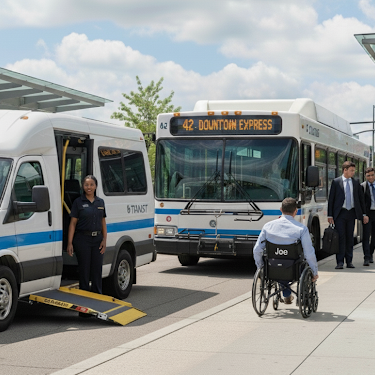
- Ramps and level boarding
The question isn’t “What do we need to build?” but “What have we already built?” That central terminal or recently upgraded stop isn’t just an amenity—it’s a launchpad for your One Transit pilot. Identify your strongest foundations and start there.
Personalized Support Stimulates Self-Agency (the case for Service Infrastructure)
Capital infrastructure provides the stage; service infrastructure is how you support the actors. It’s the human touch that leverages your physical assets to their fullest potential by giving riders confidence.
This support can be on-demand, with trained ambassadors or specialized TNC partners like Onward, SilverRide, or Uzurv available to assist a rider through a transfer. It can also be technology-driven, through apps like Be My Eyes that provide remote visual guidance for riders or systems like LookingBus that discreetly alert operators to a boarding passenger who needs extra time or attention. But the most powerful and sustainable form of service infrastructure is building rider skill and independence directly.
This is why travel training is the ultimate ROI champion. Most agencies already have these programs. The greatest return comes from evolving them beyond walking-to-the-bus-stop lessons to training riders for multi-modal trips. Toronto, for example, requires route-specific training for its “Family of Services” intermodal trips. By adapting your existing training program, you empower riders with the skills to confidently use the entire integrated network.

Your One Transit Strategy is Already Underway
Infrastructure is the strategic lens for leveraging your existing investments. The One Transit strategy is about connecting the dots between the assets you already have.
Ask your team:
- Where is the overlap? Overlay your paratransit trip data with your most accessible hubs. That intersection is your starting point.
- What can we leverage? Can your travel training program add an intermodal module? Can an existing TNC partnership support a pilot?
You don’t need a system-wide rollout. You need one corridor, one or two of your best-equipped hubs, and an existing service you can adapt. By identifying and connecting your strongest assets—your best hubs, programs, and people—you build the bridge to freedom for your riders not by starting over, but by starting from where you are.Next week, we’ll turn to Compliance, the tonic that ensures these new, flexible services are delivered equitably, responsibly, and in line with the spirit of the ADA.
Leave a Reply