
The trick to a One Transit strategy is cost-effectively bringing the frequency of fixed-routes to riders with disabilities. The easier it is for riders with disabilities to travel on your fixed-route, the more your transit will:
- 👥 Grow ridership adoption,
- 💰 Reduce costs,
- ⚖️ Deliver social equity
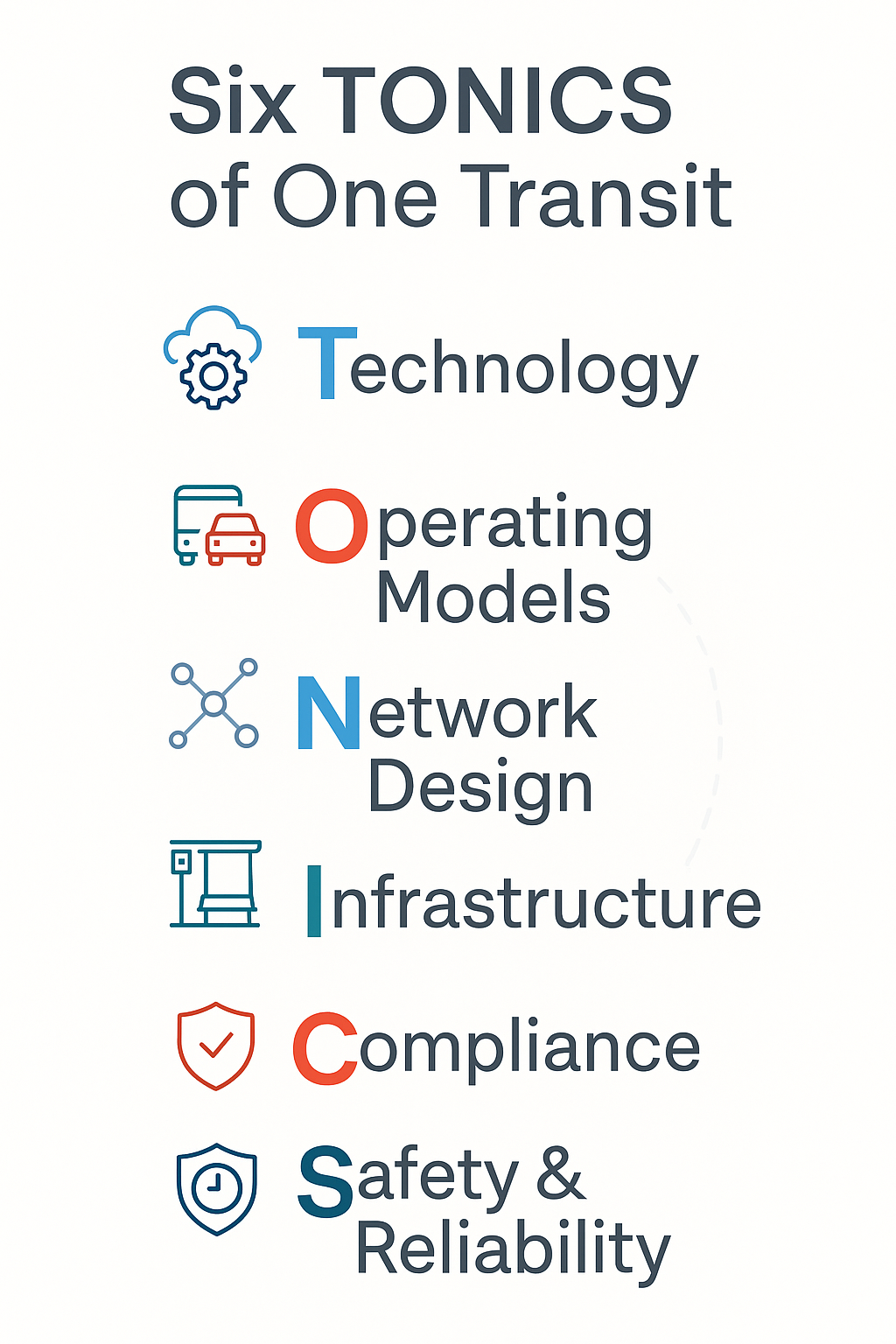
If you’re like most agencies, you already have pieces of the puzzle at hand. Last week, I introduced the “Six Tonics,” a simple framework to help you make sense of how your innovations are advancing you towards a One Transit model. Each of the six tonics works together to unlock seamless, spontaneous, and safe intermodal paratransit.
Over the next few weeks, we’re going to tangibly dive into each tonic. My goal in this series is that after reading this, you as a leader in public transit will feel empowered to take the next critical step towards piloting intermodal paratransit. You’ll understand why the strategy is important, the projects you need to prioritize to realize it, and what action to take next. If this sounds valuable, follow me to make sure you don’t miss a post (or my big announcement 😉).

We start with Technology — the most critical of the Tonics
Technology is more than the first T. It’s the foundation that unlocks success, and the reason that now is the time for this change. The single most critical difference between 1990 and 2025 is what technology is capable of.
Don’t just take it from me. When I interviewed Cameron Penman, Head of Wheel-Transit at the Toronto Transit Commission (TTC) and pioneer of TTC’s intermodal Family of Services, he was emphatic on this point:
“Paratransit software is the single most important thing. Family of Services lives and dies with scheduling/dispatch technology that can book intermodal trips.”
With the right paratransit scheduling & dispatch platform, you will be able to:
- Automatically break trips into first and last-mile legs supporting your fixed-routes
- Book trips on-demand, in real-time
- Operate efficiently by integrating new modes such as microtransit or TNCs
There are other supporting technologies that we’ll dive into at a later date — like MaaS apps and fare systems — but it’s your core scheduling and dispatch that either makes One Transit possible or keeps you stuck in yesterday’s costly, segregated system.
Is your Technology ready? Use the Scorecard to find out.
Use this practical 10-step scorecard to demystify where your technology stands today. It’s structured around two tiers: the Essential outcomes your technology must support , and the Accelerators that, well, accelerate the 💰economic value, ⚖️social value, and 👥ridership adoption resulting from your new paratransit strategy.
Let’s start with the must-haves.
The Essentials: The Keys to One Transit
It’s actually pretty straightforward. If your technology can deliver these five core outcomes (i.e. no yellow boxes on your scorecard), your tech is already equipped for intermodal paratransit. And the more green checkmarks you’ve earned? The stronger your foundation.
1. Are you already publishing GTFS data?
✅ Yes, GTFS real-time ☑️ Yes, static GTFS ⚠️ No GTFS
Your scheduling software can’t integrate with fixed-routes if it doesn’t know about them. Static GTFS gets you started, but real-time GTFS contributes to a more seamless rider experience.
2. Can you book trips that connect riders to or from fixed-route stops?
✅ Yes, automatically ☑️ With manual scheduling ⚠️ Not at all
Identifying and booking intermodal opportunities are two different things. Some systems may let you book the trip easily enough if your staff can independently recognize an effective intermodal transfer hub.
3. How well does your scheduling platform spot intermodal trip opportunities?
✅ Automatically ☑️ With manual work ⚠️ Not at all
Can your software look at a trip from A to B and suggest: “We can get you there faster and cheaper with a short ride to the transit center, then the Blue Line direct to your destination”? While manual workarounds won’t scale, they can definitely get you through a proof-of-concept pilot.
4. Can riders book same-day trips?
✅ Yes, in real-time ☑️ Yes, with a +2-hour window ⚠️ No same-day trips
Remember: spontaneous mobility is the entire point. If riders still need to book a day ahead, you’re not solving the paratransit paradox—you’re just making it more complicated. Even a two-hour window opens up possibilities.
5. Can dispatchers easily adjust trips and manifests?
✅ Yes, seamless overrides ☑️ Some manual workarounds ⚠️ No controls
Here’s where technology meets humanity. Sometimes a rider needs special accommodation, especially in response to a missed transfer. Your dispatchers need the power to quickly intervene to support the real-world experience of your riders.
It’s really as simple as that. With just these five basic outcomes from your software, you can pilot a One Transit strategy.

Accelerators: Drive Results Faster
Accelerators aren’t blockers to launching a pilot, but they’re the difference between modest success and transformational results. They interact with the five other tonics in a way that amplifies three measurable outcomes. 💰⚖️👥
6. Can you steer transfers to specific routes or hubs?
✅ Easily ☑️ Some workarounds ⚠️ No
Drives: 👥Adoption
Related Tonics: Network design, Infrastructure
Start your pilot with your highest-frequency route(s) and best-designed transfer hub(s). You’re much more likely to attract riders when the system connects to your high-frequency lines instead of an infrequent local bus, or to your accessible transit center rather than at a bare-bones stop.
7. Can you dispatch trips to non-dedicated providers (NDSP)?
✅ Automatically ☑️ Manually ⚠️ No
Drives: 💰 Economics
Drives: ⚖️ Social value
Related Tonics: Operating modes
NDSPs are a great tool to cost-effectively deliver immediate trips. When your dedicated fleet is maxed out, can you seamlessly shift trips to Uber/Lyft, Uzurv/SilverRide, or local taxi companies such as zTrip? Automatic dispatch means no delays, but manual dispatch still unlocks the value.
8. Does your system adapt routes in real time?
✅ Automatically ☑️ Manually ⚠️ No
Drives: ⚖️ Social value
Drives: 👥Adoption
Related Tonics: Safety
When transferring to routes with lower headways, time is of the essence. Routing that responds to real-world conditions is more reliable than static routes. Reliability is a social value that grows ridership.
9. Can your technology commingle paratransit with microtransit?
✅ Seamlessly ☑️ Partially ⚠️ No
Drives: 💰 Economics
Related Tonics: Operating modes, Network design
Fleet commingling is where the economics really shine. When the same vehicle can handle an ADA paratransit trip alongside a microtransit trip, you’re maximizing asset utilization. Microtransit is now a proven mode that complements high-frequency routes by filling in coverage gaps..
10. Are you tracking conditional eligibility?
✅ Comprehensively ☑️ Partially ⚠️ Not at all
Drives: ⚖️ Social value
Related Tonics: Compliance
True social equity meets individuals where they are at, and not every rider can use fixed-route. Conditional eligibility is a powerful tool to ensure intermodal trips are only offered to riders who are actually capable of using the option, enabling you to maintain comfortable compliance with the ADA (or your provincial equivalent).
You’ll notice that these accelerators interact with each of the remaining tonics. That’s because technology is the modern glue that binds every discipline together. We’ll be diving into each tonic in more detail in the coming weeks.
You’ve filled out your scorecard. What next?
If your scorecard has any yellow ⚠️ essentials, then your path is clear. Your first step is modern scheduling and dispatch technology. There’s a reason it’s become popular to upgrade paratransit scheduling and dispatch software. Platforms like Hastus by Giro or Pingo by The Routing Company are already built to support intermodal paratransit. The key to procurement is making sure your new software isn’t boxed in to simply replicating the old way of isolating paratransit completely from fixed-route. Use this scorecard as a reference to get you started—it sets the stage for One Transit.
But what if you scored well on the Essentials? Then you’re closer than you think to launching a pilot. The technology foundation is there—now it’s about bringing the other five tonics together strategically. Start identifying which routes and corridors make the most sense for intermodal connections, and begin conversations with your operations team about how to test this safely and effectively.
Remember: you don’t need perfect technology to start. You need good enough technology to learn. The TTC didn’t wait for the perfect system—they started with what they had and improved as they went, growing Family of Services year on year. Your riders aren’t waiting for a flawless system; they’re waiting for spontaneous mobility today.
Next up in this series, we’ll dive into Operating Models: how to piece together your One Transit operations, from microtransit and commingling to strategic use of TNCs. Click +Follow to make sure you don’t miss it, and be first to know when the full Scorecard is available for you to download!
How many checkmarks did you get? I’m curious to hear where agencies are landing on this scorecard, and what your biggest technology gaps are.
Need help thinking through your next steps? Message me! I love talking through these challenges with transit leaders who are ready to move beyond the status quo.
Leave a Reply