
Why Frequency Equals Freedom (The Research Foundation)
Over the last 15 years, there’s been a radical shift in how the transit industry defines good network design. The research is in: frequency, not mere coverage, trumps all else when it comes to attracting and retaining riders. A system with two high-frequency lines and a transfer (say, each running every 10 minutes) will almost always outperform a one-seat ride that comes once an hour.
(Source: Eby, B., Lewis, P., Calves, G., & Sampson, D. (2021). Redesigning Transit Networks for the New Mobility Future (TCRP Research Report 221). “Deciding not to provide direct connections between many origin-destination pairs and instead require transfers can result in improved frequency on high ridership routes… can increases overall accessibility and result in more cost-effective service.”)
In a One Transit strategy, we apply this same logic to paratransit riders. They’re clamoring for same-day options. This isn’t surprising, as folks without disabilities increasingly enjoy spontaneous access via Uber, Lyft, taxis, and fixed-route transit. The real promise of One Transit is to bring that same freedom and spontaneity to ADA riders, too.
But that freedom breaks down fast if your fixed routes aren’t pulling their weight. You could have the best operating model in the world—on-demand pickups, short wait times, state-of-the-art tech—but if you’re connecting riders to a trunk line that only runs every 60 minutes, the entire trip falls apart.
Network design isn’t just a nice-to-have. It’s the absolute foundation of an equitable and efficient transit system. In an era of severe budget cuts, network design is a huge opportunity to save money and improve service.

Toronto’s Blueprint: How High-Frequency Routes Delivers 50% Savings in Paratransit
The Toronto Transit Commission’s Family of Services program has been successfully implementing intermodal paratransit since 2017. Eligible riders are offered trips that combine an on-demand paratransit vehicle for one leg with a transfer to a high-frequency fixed route for the rest.
Key design choices made this work:
- Headway Discipline: They only offer transfers to routes with strong headway, all less than 20 minutes.
- Vetted Transfer Points: They pre-vet transfer points for safety, accessibility, and rider comfort. (come back next week for a deep-dive into the Infrastructure Tonic)
- Strategic Targeting: They target specific destinations where intermodal connections can meaningfully substitute for full door-to-door service.
The result? A remarkable 50% reduction in cost per passenger for those trips, with about one-third of eligible riders opting in.

But perhaps the most important takeaway is this: TTC didn’t redesign the whole system overnight. They piloted first. Carefully. Strategically. And you can achieve similar results.
Your Path Forward: Start Small, Scale Smart
Immediate Opportunity — Tactical Pilots
To kickstart your efforts, begin by assessing your current network:
- Do you have any routes operating at 20-minute headways or better?
- If not, what about 30 minutes?
Once you’ve identified potential corridors, take these next steps:
- Pick your corridors: Identify the highest-frequency fixed routes in your system.
- Overlay paratransit demand: Look at your trip data. How many ADA trips already begin or end near these corridors?
- Offer a simple intermodal option: If a rider’s trip aligns, offer them same-day service to the nearest safe transfer point along the corridor. To start, don’t try to design multi-transfer journeys or system-wide rollouts: just focus on one-transfer, high-impact trip opportunities.
🧠 Frequency and Equity Relationship: Wait Time Variance
Don’t just look at the average wait time. Look at the variance. At a 30-minute headway, the average wait-time is 15 minutes. But if an abled person independently manages to wait only 5-10 minutes, but a paratransit rider dependent on a first-leg journey risks missing a transfer and waiting a full 30 minutes, that’s not an equitable experience. The average wait-time is the same, but the variance is totally different. Wait time variance is one of the most overlooked equity metrics in transit design.
A Simple Heuristic for Headways:
- If your headways are short (~15-20 minutes), you can relax a bit—missed transfers aren’t trip-ending.
- If they’re longer (up to 30 minutes), your technology, dispatch controls, and missed-transfer recovery plans become more critical.
A successful pilot doesn’t need to be complex. It just needs to be:
- Targeted to a high-frequency corridor
- Focused on same-day trips
- Designed with an opt-in workflow that reservationists can easily follow
- And most importantly, built around clear metrics of success: opt-in rate, cost savings, transfer reliability

Long-term Strategy — Network Redesign
Many agencies are already engaged in comprehensive operations analyses or short-range transit plans. If that’s your agency, here’s a crucial nudge: actively integrate your paratransit data when deciding where to prioritize high-frequency investment.
You may find that some corridors not only improve ridership but also unlock significant paratransit savings. Don’t overlook your ADA trips—they’re often where the cost savings hide.
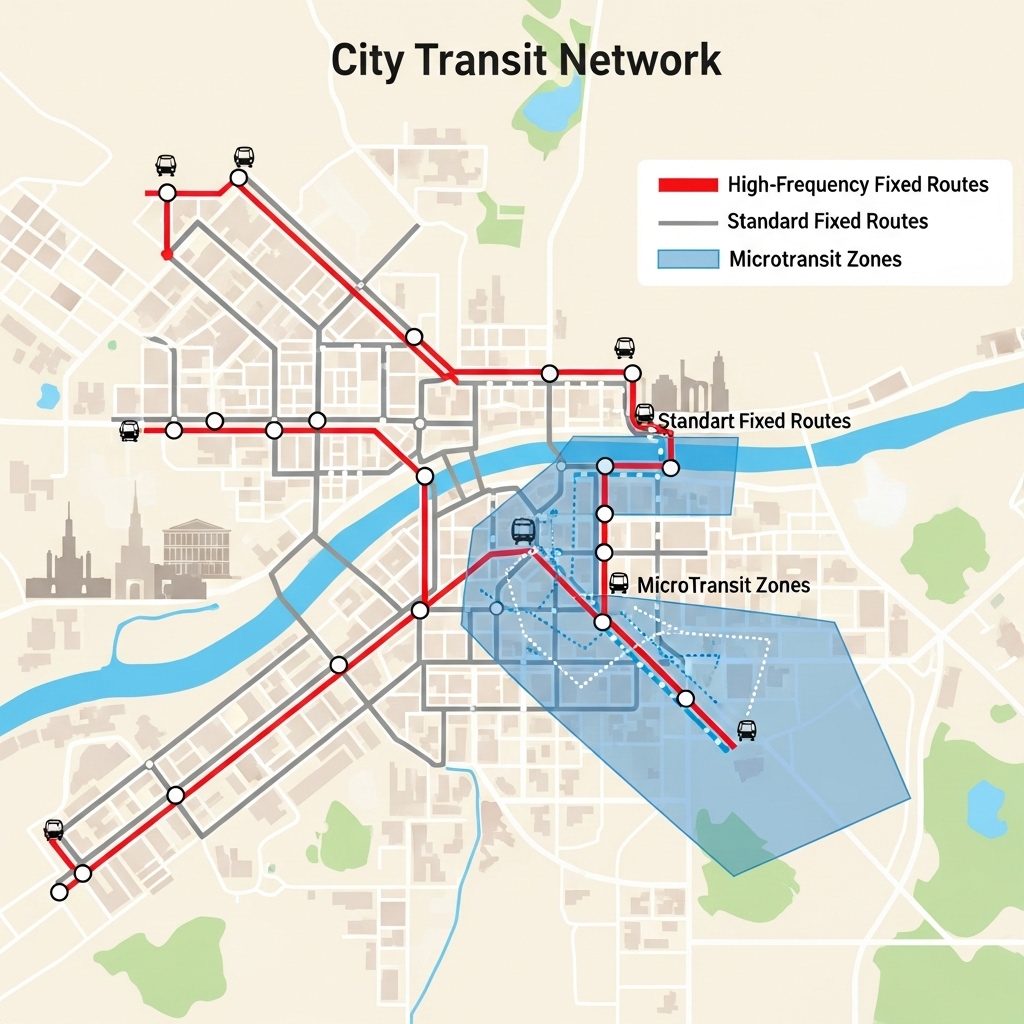
An integrated One Transit network typically features:
- High-frequency trunk lines serving key destinations like Walmart, hospitals, and senior centers.
- Microtransit zones strategically placed to feed, not compete with, those trunks—often replacing fixed-routes that can’t meet a 30-minute headway
- ADA paratransit that seamlessly connects into the system rather than operating entirely outside of it.
- Commingled operations where the same vehicles serve both microtransit and paratransit riders under a unified tech stack.
The design principle is simple: Don’t treat paratransit, microtransit, and fixed route as separate systems. Design them as integrated layers of a single network.

Ready to Transform Your Network Design?
You could deploy the most sophisticated demand-response software and the most efficient routing algorithm available—but if your fixed routes are running on 60-minute headways, riders still won’t experience the freedom and spontaneity they’re asking for. A well-designed frequent network is what truly makes intermodal paratransit a reality.
In today’s reality where agencies in Pennsylvania, Oregon, and Illinois are experiencing severe budget cuts, there is in fact opportunity in the chaos: network design is likely something you’re already doing. Every Comprehensive Operations Analysis (COA), every redesign plan, every service expansion or contraction presents an opportunity to integrate ADA needs from the outset, rather than bolting them on as an afterthought.
Paratransit doesn’t have to be a cost sink. With One Transit thinking, it transforms into a strategic asset—a powerful lever for both greater equity and substantial savings.

Ready to start your journey towards a more integrated and effective transit network? KTS specializes in comprehensive COAs and network redesign projects, as well as hands-on pilot support to prove and scale intermodal paratransit concepts. Let’s discuss how we can help you achieve significant savings and enhanced rider freedom.
Leave a Reply