
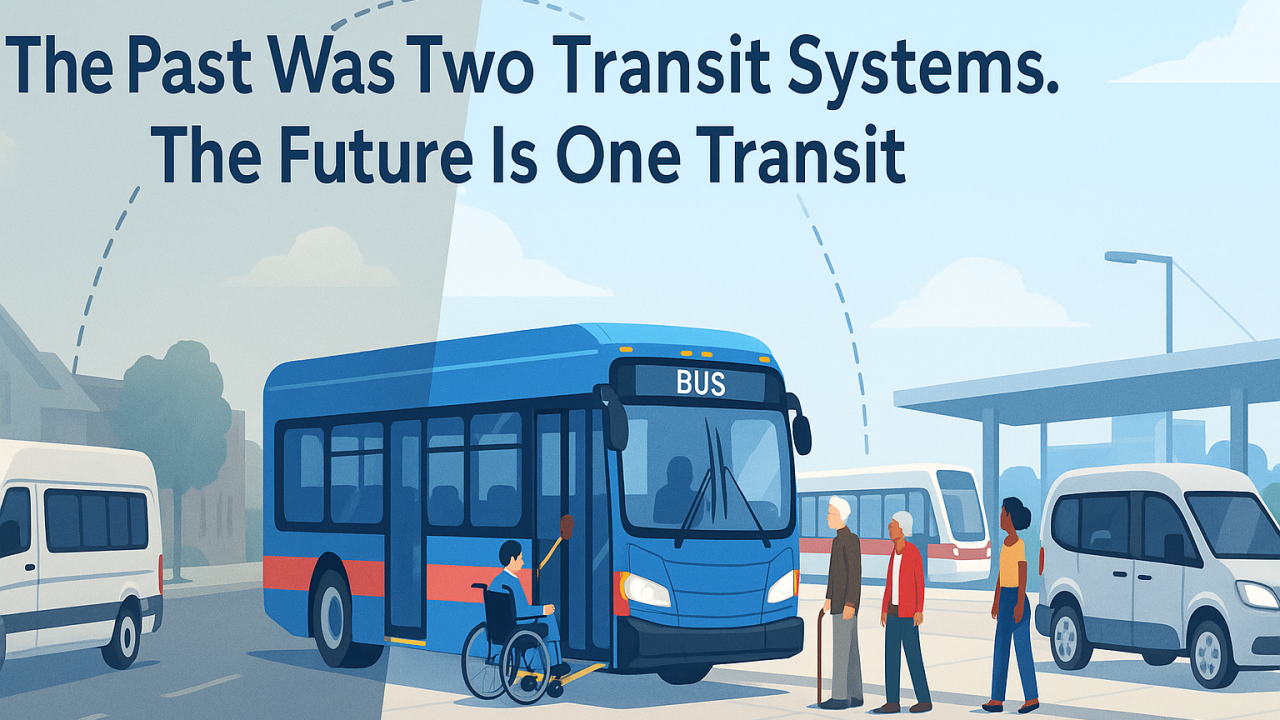
Paratransit was designed as a compromise between transit agencies and individuals who are unable to use fixed-route transit: it promised equitable mobility in a way that didn’t blow up the transit budget. But the way we do paratransit is no longer sustainable economically nor socially.
At its heart stands a troubling paradox: despite enforcing day-before booking, it’s still increasingly expensive to operate. And despite complying with the ADA, riders increasingly demand same-day service. Demand is growing rapidly with the Silver Tsunami, and transit is now expected to deliver high frequencies for true freedom. Paratransit wasn’t built for 2025—and definitely not for 2035. Something is going to break, unless we reinvent how we deliver accessible transit.
The One Transit Strategy: Same-Day Intermodal Paratransit
Let’s go back to first principles by solving how to actually make fixed-route accessible—and it starts with simply getting to the bus stop. Imagine a world where paratransit isn’t a silo operating redundant travel patterns, but a seamless extension of your entire transit network that connects to your core corridors. Same-day intermodal paratransit is the heart of the One Transit strategy: re-designing paratransit so that door-to-door trips are shorter and less expensive, fixed-route ridership grows, and riders with disabilities gain freedom of same-day service. By re-investing the cost-savings back into a frequency-based accessible network, your entire community benefits. Solving the paratransit paradox will actually strengthen all of transit.
Take Toronto, where the Toronto Transit Commission (TTC) has transformed travel for riders with disabilities. Their Family of Services program has embraced intermodal paratransit since 2017. By combining door-to-door segments with high-frequency buses and trains, they’ve cut their per-trip paratransit costs by nearly 50%. And more importantly, riders choose to take the route with transfers!
The TTC has proven the One Transit hypothesis. So the question becomes: how do you get there too?
Good News: You’re Already On Your Way (Meet the Six TONICS)
While adopting intermodal paratransit may seem daunting, chances are your agency already has pieces of the solution in place. The key is to bring them together strategically so that they all work together towards a One Transit strategy. I’ve created a framework that simplifies this, by placing each transit initiative into one of Six TONICS:
- Technology: Adopt paratransit scheduling & dispatch software that can book intermodal trips and commingle microtransit & paratransit; release an app that guides riders across modes.
- Operating models: Operate microtransit to replace local paratransit trips; commingle paratransit and microtransit fleets; use TNCs or taxis for same-day trips; launch a same-day rescue provider.
- Network design: Embrace high-frequency corridors with BRT, LRT, or 20-minute headways; rethink low-productivity fixed routes to connect better with trunk lines; have microtransit or TNCs fill in the gaps.
- Infrastructure: Prioritize intermodal transit hubs; ensure accessible stops have clear wayfinding; invest in fixed-route accessibility features like AVA or low-floor boarding.
- Compliance: Re-train fixed-route operators on accessibility & sensitivity; use conditional eligibility as a tool to incentivize fixed-routes; let riders opt into non-ADA paratransit to relax cost constraints.
- Safety & Reliability: Introduce travel training initiatives; track rider perceptions of safety; deliver consistent on-time performance for every mode; staff trained ambassadors at transit hubs.
If you’re like many agencies, your most recent high-priority initiatives likely fit into these categories. You already have the building blocks of a One Transit system. Now, you just need to put it together.
Here’s What to do Next:
Start by taking stock. Map your existing and planned initiatives against the Six TONICS. Which TONICS are already strong? Where are the gaps? This exercise alone often reveals that you’re much closer to operating One Transit than you think.
Next, identify which projects are must-haves versus nice-to-haves for your community. For many, that means prioritizing software upgrades to support commingled fleets, or launching microtransit in low-density areas to shift paratransit trips onto shared vehicles. For others, it’s about doubling down on high-frequency corridors to make the fixed-route attractive and reliable. Or you may invest in travel training, wayfinding and/or stop accessibility so that all riders can confidently use fixed routes.
Then, design a pilot that puts these pieces together—you don’t have to launch it all at once! Start small: pick a zone or corridor where you can blend modes: it could be a high-frequency route, or an area where paratransit demand overlaps your network over long legs. Establish clear goals, measure outcomes, and most importantly listen to your riders—especially those with disabilities—to make sure your strategy truly delivers on freedom and dignity.
Solving the paratransit paradox isn’t just about paratransit. It’s about building a unified, efficient, and inclusive transit system that works better for everyone. It’s the natural culmination of 30 years of transit innovation.
The past was two transit systems. The future is One Transit. Let’s get there together.
About the Author
Stephen Kuban is the founder and CEO of Kuban Transit Solutions. He is passionate about sustainable transit strategies that enhance accessibility and efficiency within public transportation systems. With a vision for a unified transit network, Stephen champions innovative solutions that address the growing mobility needs of all community members.

Leave a Reply