
The goal of One Transit is simple: deliver modern fixed-route frequency to riders with disabilities—ideally 15 minute headways. Hitting that gold standard takes a blend of strategies that must take into consideration demand density, geography, and demand patterns, not to mention the quality of the existing fixed-route itself. The key is choosing the right operating model for the context.
There is no one silver bullet operating model. Each can work together in a One Transit network, and the best fit depends on the conditions of the area being served. We will explore five distinct approaches to low-wait time on-demand transit.
- Zonal microtransit
- Unbound on-demand
- Network-bound on-demand
- Deviated fixed routes
Except for deviated routes, each mode can be served by both dedicated fleets or non-dedicated service providers (NDSPs) including taxis and TNCs such as Uber , UZURV – The Adaptive TNC , or SilverRide. And by commingling each of these operations with your paratransit fleet, you unlock true sustainability.

Each mode works together in a cohesive network, because each excels under different conditions.
1. Zonal Microtransit
These are geographically bounded on-demand services using agency-operated vehicles. They offer flexibility within a zone but don’t guarantee connections to the broader network. Zonal microtransit works best in moderate-demand suburban or spread-out areas where they serve trip patterns that traditional fixed route simply can’t effectively serve.
Zonal microtransit should always serve the general public, filling in network gaps where the fixed-route can’t effectively deliver ridership and headways under 30 minutes. We will revisit this next week when we discuss the Network Design tonic.

Zonal microtransit serves travel patterns exclusively within defined zones.
In areas with medium density, dedicated fleets typically are most efficient. Examples of zonal microtransit using dedicated fleets include: VIA Link Naco Pass by San Antonio Via Metropolitan, and Kitsap Transit’s BI Ride.
On the other hand, areas with a low demand-density may see more cost savings and better wait-times when they embrace non-dedicated service providers (NDSPs) such as taxis or TNCs like Uber, Uzurv, and SilverRide. Examples of zone-bound on-demand with NDSPs include DART’s GoLink in Dallas.
2. Unbound On-Demand
Unbound models allow trips anywhere within a jurisdiction, without being tied to hubs or corridors. ADA Paratransit is an example of unbound on-demand: riders can go nearly anywhere. Unbound on-demand also works in areas with minimal or no fixed-routes, where on-demand is the primary mode; these are often called “dial-a-ride” services.
When fixed-routes are effective, I strongly recommend against introducing general public service in this way. Instead, these modes are more often used to support eligibility-based paratransit, such as overflow trips or “space available” on-demand.
Dedicated Fleets (Space-Available): Riders can request same-day trips if there’s vehicle availability, often using the agency’s paratransit fleet, which we see in Dayton RTA and in SamTrans in California.
Non-Dedicated Service Providers (NDSPs): Taxis and TNCs (e.g., Uber, Lyft, USERV) tend to work best as overflow or same-day providers in dense regions, where their presence is strong. However, in these dense areas and in contrast to zonal microtransit, they should remain limited to eligible riders only—such as in New York City Transit’s e-Hail program.
3. Network-Bound On-Demand
Network-bound on-demand is an emerging service type that constrains on-demand trips to align with the fixed-route network. Rather than being restricted to a zone as in zonal microtransit, allowable trips are based off connecting fluidly to the right fixed-routes.
These models are best suited to moderate-to-high-density environments with some fixed-route coverage, ensuring integration while expanding flexibility. Successful examples include the Family of Services in Toronto Transit Commission (TTC) and York Region Transit.

Network-Bound on-demand limits trips to connect with the network, rather than by zones.
Since there is no zone, a single dedicated fleet doesn’t work. Effective service here requires using either NDSPs, or commingling with your general paratransit fleet as space is available.
4. Deviated Fixed-Routes
These operate along a semi-fixed path but can deviate to pick up eligible riders. They work best in low-density areas where demand doesn’t support either full dial-a-ride, but it does support a fixed-route. Deviated routes are the best way to efficiently meet your ADA obligations in rural connector transit by avoiding the significant deadhead of a dedicated paratransit fleet. Examples include the rural transit operated by Rochester Genesee Regional Transportation Authorty in New York.

Instead of paratransit, RGRTA let their sub-rural fixed-routes deviate to fulfill ADA obligations.
Bonus: Commingling as the efficiency engine
While all of the above models can work using separate softwares and separate operations, the keys to efficiency lay in commingling—when a single fleet of vehicles can fluidly operate any of these customer-facing services. We explored this in the Technology Tonic post last week.
Toward a Right-Sizing Framework
There’s no one-size-fits-all model. Instead, we should evaluate the right mix using a few key filters:
- ADA Trips per Square Mile: Demand density gives a first approximation of required coverage.
- Travel Pattern Concentration: Are rider origins/destinations clustered or dispersed? This is often a result of the land use context: traditional zoning restrictions often stimulate corridor travel, whereas mixed zoning often sees more fluid movement patterns.
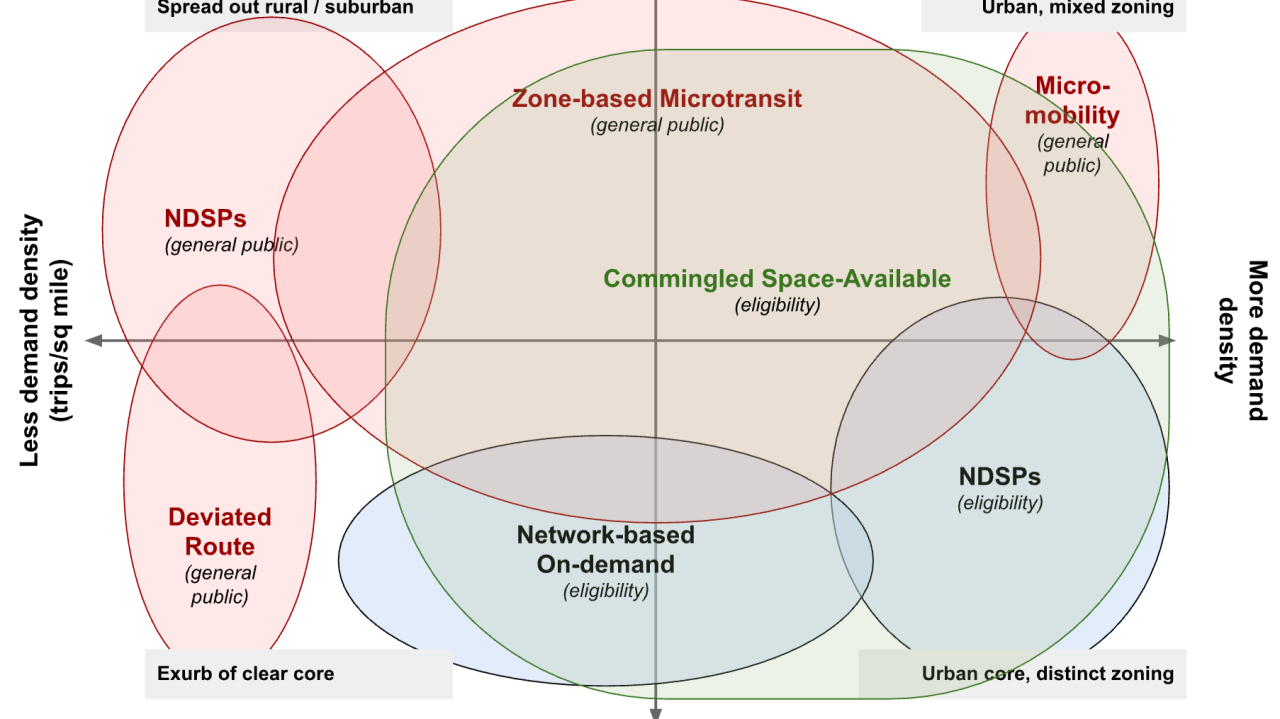
Together, these dimensions help define where each model fits best. I’ve done my best to roughly map out how you could piece together each service based on demand density and the travel patterns of your service area.

Effective on-demand transit matches the right Operating Mode to your local context.
📍In areas with high demand and clustered travel, network-bound or commingled same-day services thrive, while you will typically see trip restrictions based on eligibility.
📍In areas with low density and scattered trips, general public services are king, including NDSPs, zonal microtransit, or deviated routes.
(Special note as well for micromobility e.g. scooters, bikes. I personally think these are great for short-distance trips. Research is emerging about ways to increase the accessibility of micromobility.)
What’s Next: Putting the Pieces Together
Have you been thinking about introducing microtransit or TNCs, but not sure how they’d fit? Already running deviated routes, but wondering if there’s a better option? Or maybe you’ve launched one of these models and are trying to figure out if it’s working?
Use the diagram as a cheat sheet. Map your demand density and travel patterns, then see where each model naturally fits. It’s not about picking the “best” service—it’s about constructing the right mix that works together.
And if you want a second set of eyes, shoot me a message. I’m always happy to take a look.
Next week we’ll turn to “N,” our third tonic: Network Design—how to structure your fixed routes and on-demand zones so they reinforce each other, not compete. Because a great system doesn’t come from one model. It comes from all the pieces working in concert.
Leave a Reply